THE PREDICTION MODEL FOR ELECTRIC VEHICLES ADOPTION RATE IN MALAYSIA
DOI:
https://doi.org/10.11113/jtse.v12.249Keywords:
Electric vehicles, Malaysia, Theory of Planned Behaviour, SARIMAX, LSTM modellingAbstract
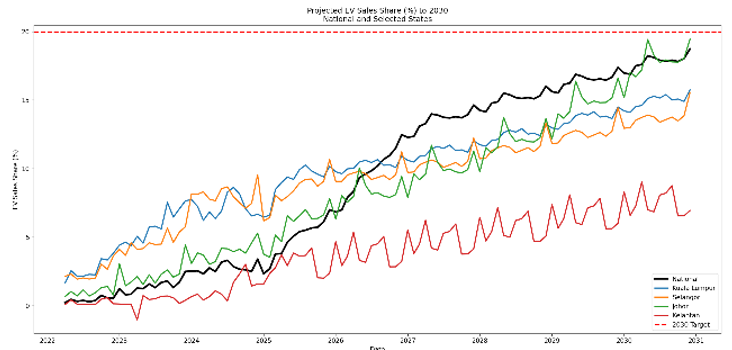
This comprehensive study presents an integrated analysis of electric vehicle (EV) adoption in Malaysia, combining behavioural research, advanced predictive modelling, and policy assessment to evaluate the country's readiness for sustainable transportation transition. The research employed a sequential mixed-methods approach, integrating a validated Theory of Planned Behaviour (TPB) survey with hybrid forecasting models to assess current adoption trends and project future scenarios through 2030. A two-phase TPB survey was conducted with a pilot test (n=50) and main survey (n=500), achieving excellent reliability across all constructs (Cronbach's α = 0.802-0.850). Advanced modelling framework combining SARIMAX, LSTM, and weighted ensemble approaches achieved excellent predictive accuracy at the national level (R² = 0.822). Key findings reveal that while Malaysia's EV market demonstrated 45.6% growth in Q1 2025, reaching 6,827 units, no region is projected to meet the 20% 2030 adoption target under current trajectories. Current infrastructure deployment stands at 4,161 charging stations, representing 41.6% progress toward 2025 targets. Behavioral analysis indicates perceived behavioral control as the primary barrier despite positive consumer attitudes. Strategic recommendations include accelerating rural charging infrastructure, extending fiscal incentives beyond 2025, and implementing targeted behavioural interventions.
References
Ministry of Transport Malaysia, 2025. National EnergyTransition Roadmap Progress Report, GovernmentPublications, Kuala Lumpur.
Norwegian Road Federation, 2024. Electric Vehicle MarketStatistics 2023, Annual Report, Oslo, Norway.
China Association of Automobile Manufacturers, 2024.New Energy Vehicle Market Analysis Report, Beijing,China.
Umair M., 2024. A Review of Malaysia's Current State andFuture in Electric Vehicle Adoption, Journal of SustainableDevelopment of Energy, Water and Environment Systems,12(0522): 245-267.
Ibrahim M.F., Prakasam S. and Ahmad A.A., 2025.Evaluating the Feasibility of Electric Vehicles in Malaysia:Current Challenges and Future Prospects, Environment-Behaviour Proceedings Journal, 10(SI32): 156-178.
Chenayah S., 2024. Adoption of Electric Vehicles inMalaysia, Asia-Pacific Journal of Operational Research,41(06): 2445005.
Ajzen I., 1991. The Theory of Planned Behavior,Organizational Behavior and Human Decision Processes,50(2): 179-211.
Wee W.Y., 2024. Factors Influencing Adoption of ElectricVehicle among Car Users in Malaysia, Master of ScienceThesis, Faculty of Business and Finance, Universiti TunkuAbdul Rahman, Malaysia.
Francis J.J., Eccles M.P., Johnston M., Walker A., GrimshawJ., Foy R., Kaner E.F.S., Smith L. and Bonetti D., 2004.Constructing Questionnaires Based on the Theory ofPlanned Behavior: A Manual for Health ServicesResearchers, Centre for Health Services Research,University of Newcastle, UK.
Box G.E.P. and Jenkins G.M., 1976. Time Series Analysis:Forecasting and Control, Holden-Day, San Francisco, USA.
Hochreiter S. and Schmidhuber J., 1997. Long Short-Term Memory, Neural Computation, 9(8): 1735-1780.
Xia, Z., Wu, D., & Zhang, L. (2022). Economic, Functional,and Social Factors Influencing Electric Vehicles’ Adoption:An Empirical Study Based on the Diffusion of InnovationTheory. Sustainability 2022, Vol. 14, Page 6283, 14(10),6283. https://doi.org/10.3390/SU14106283.
XU, W., Gordon, F., Wells, P., LI, J., & Harris, I. (2025).Impacts of Consumers’ Heterogeneity on Decision-Makingin Electric Vehicle Adoption: An Integrated Model.https://doi.org/10.2139/SSRN.5195524.
Yu, T., Teoh, A. P., Liao, J., & Wang, C. (2025).Determinants of switching intention to adopt electricvehicles: A comparative analysis of China and Malaysia.Technology in Society, 82, 102949.https://doi.org/10.1016/J.TECHSOC.2025.102949.
Zhang, T., Burke, P. J., & Wang, Q. (2024). Effectiveness ofelectric vehicle subsidies in China: A three-dimensionalpanel study. https://acde.crawford.anu.edu.au/acde-research/working-papers-trade-
Zhao, F. (2022). Cross-Cultural Study of the Attitudes ofRussian and Chinese Consumers Toward Electric Vehicles.Frontiers in Psychology, 13, 820584.https://doi.org/10.3389/FPSYG.2022.820584/BIBTEX.
Zhao, X., Li, X., Jiao, D., Mao, Y., Sun, J., & Liu, G. (2024).Policy incentives and electric vehicle adoption in China:From a perspective of policy mixes. TransportationResearch Part A: Policy and Practice, 190, 104235.https://doi.org/10.1016/J.TRA.2024.104235.
Zhou, Y., Dai, W., & Xiao, M. (2025). Beyond the Battery:The Impact of Cultural Factor on Electric VehicleConsumers’ Service Quality Expectations in Dealerships.World Electric Vehicle Journal 2025, Vol. 16, Page 229,16(4), 229. https://doi.org/10.3390/WEVJ16040229.
Refor, D., Ray, M., & Harito, C. (2023). Influential FactorsAffecting the Adoption Intention of Electric Vehicles inIndonesia: An Extension of the Theory of PlannedBehavior. Engineering, MAthematics and ComputerScience Journal (EMACS), 5(3), 117–128. https://doi.org/10.21512/EMACSJOURNAL.V5I3.10525. [20]Riverso, R., Altamura, C., & La Barbera, F. (2023). Consumer Intention to Buy Electric Cars: Integrating Uncertainty in the Theory of Planned Behavior. Sustainability 2023, Vol. 15, Page 8548, 15(11), 8548. https://doi.org/10.3390/SU15118548. [21]Saleh, H. N., Maupa, H., Cokki, & Sadat, A. M. (2025). Factors Affecting the Intention to Buy Electric Vehicles Through the Integration of Technology Acceptance Model and Prior Experience. Journal of Applied Data Sciences, 6(2), 1392–1412. https://doi.org/10.47738/jads.v6i2.730. [22]Salim, A., Syafri, & Nasrullah. (2024). Accelerating Sustainability Environment: Understanding Electric Vehicles (EVs) Adoption with Expanded Technology Acceptance Model (TAM). International Journal on Advanced Science, Engineering and Information Technology, 14(2), 629–640. https://doi.org/10.18517/IJASEIT.14.2.19996. [23]Samawi, G. A., Bwaliez, O. M., Jreissat, M., & Kandas, A.(2025). Advancing Sustainable Development in Jordan: A Business and Economic Analysis of Electric Vehicle Adoption in the Transportation Sector. World Electric Vehicle Journal 2025, Vol. 16, Page 45, 16(1), 45. https://doi.org/10.3390/WEVJ16010045. [24]Gupta, S., Bansal, R., Bankoti, N., Kar, S. K., Mishra, S. K., Kaur, P., & Harichandan, S. (2024). Factors Affecting Consumer’s Intention to Use Electric Vehicles: Mediating Role of Awareness and Knowledge. Journal of Advanced Transportation, 2024(1), 5922430. https://doi.org/10.1155/2024/5922430. [25]Hasri, D., & Barus, N. (2024). The Market Interest of Electric Vehicle in ASEAN Through Digital Analytics and Industry Performance. JAS (Journal of ASEAN Studies), 12(2), 283–303. https://doi.org/10.21512/JAS.V12I2.9091. [26]He, X., & Hu, Y. (2024). The Decision-Making Processes for Consumer Electric Vehicle Adoption Based on a Goal-Directed Behavior Model. World Electric Vehicle Journal, 15(9), 386. https://doi.org/10.3390/WEVJ15090386/51
Downloads
Published
Issue
Section
License
Copyright of articles that appear in Journal of Transpot System Engineering (JTSE) belongs exclusively to Penerbit Universiti Teknologi Malaysia (Penerbit UTM Press). This copyright covers the rights to reproduce the article, including reprints, electronic reproductions or any other reproductions of similar nature.
Disclaimer: The views and opinions expressed in the articles are those of the authors and do not necessarily reflect the official policy or position of the JTSE. Examples of analysis performed within are only examples and they should not be utilized in real-world. Assumptions made within the analysis are not reflective of the position of any JTSE entities.