A COMPARATIVE ANALYSIS OF ENERGY CONSUMPTION AND CO2 EMISSIONS FOR ENERGY-EFFICIENT VEHICLES IN MALAYSIA
DOI:
https://doi.org/10.11113/jtse.v13.264Keywords:
Energy-efficient vehicles, vehicle energy consumption, hybrid electric vehicles, electric vehicles, CO₂ emissions, MalaysiaAbstract
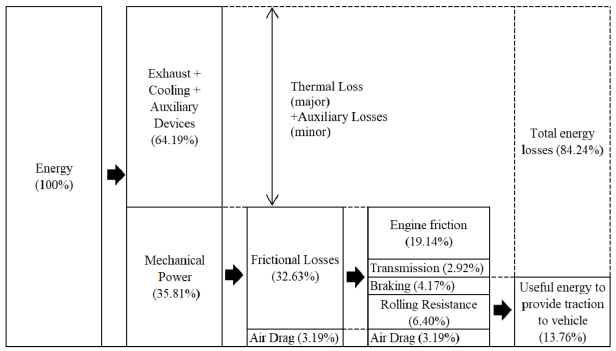
Malaysia’s road transport sector contributes significantly to national energy consumption and CO₂ emissions. This study develops a simplified comparative model to assess the operational energy use and CO₂ emissions of gasoline internal combustion engine vehicles (ICEVs), hybrid electric vehicles (HEVs), and electric vehicles (EVs) under Malaysian passenger-car conditions. Useful traction energy was estimated at 13.76%, 23.48%, and 69.19% for ICEVs, HEVs, and EVs, respectively. Compared with ICEVs, HEVs and EVs reduced annual operational CO₂ emissions by 38.69% and 45.96%, respectively, although EV performance remains strongly dependent on the electricity-generation mix. Scenario analysis indicates that electrification alone is unlikely to deliver rapid transport-sector decarbonisation without aggressive adoption, grid decarbonisation, and supporting infrastructure. HEVs and improved ICEV technologies can provide short- to medium-term transition benefits, while EVs offer stronger long-term potential with the expansion of renewable electricity, charging infrastructure, and clear policy support. The findings support a balanced transition strategy that combines electrification, vehicle efficiency improvements, and power-sector decarbonisation.
References
National Aeronautics and Space Administration. (n.d.). The causes of climate change. https://climate.nasa.gov/causes/
Ghadimzadeh, A., Makmom, A. A., Hosea, M. K., Asgari, N., Shamsipour, R., Askari, A., & Narany, T. S. (2015). Review on CO₂ emission from transportation sector in Malaysia. IOSR Journal of Environmental Science, Toxicology and Food Technology, 9(5), 61–70.
Ministry of Environment and Water. (2021). Low Carbon Mobility Blueprint 2021–2030. https://www.kasa.gov.my/resources/alam-sekitar/Low-Carbon-Mobility-Blueprint-2021-2030.pdf
Paris Process on Mobility and Climate. (n.d.). Paris Agreement on climate change: A strong call to action for the transport sector. http://www.ppmc-transport.org/paris-agreement-on-climate-change-a-strong-call-to-action-for-the-transport-sector/
Ministry of Science, Technology and Innovation. (2015). Intended Nationally Determined Contribution of the Government of Malaysia. United Nations Framework Convention on Climate Change.
Amran, A. N. Q., Ma’aram, A., & Sutopo, W. (2025). The prediction model for electric vehicles adoption rate in Malaysia. Journal of Transport System Engineering, 12(2), 1–8. doi:10.11113/jtse.v12.249
Holmberg, K., Andersson, P., & Erdemir, A. (2012). Global energy consumption due to friction in passenger cars. Tribology International, 47, 221–234.
Chong, W. W. F., Ng, J. H., Rajoo, S., & Chong, C. T. (2018). Passenger transportation sector gasoline consumption due to friction in Southeast Asian countries. Energy Conversion and Management, 158, 346–358.
Yang, S. C., Li, M., Lin, Y., & Tang, T. Q. (2014). Electric vehicle’s electricity consumption on a road with different slope. Physica A: Statistical Mechanics and Its Applications, 402, 41–48.
Md Raimi, M. R., & Abu Bakar, S. A. (2024). Simulation study on regenerative braking system in electric vehicle (EV). Journal of Transport System Engineering, 11(2), 1–6. doi:10.11113/jtse.v11.208
Natural Resources Canada. (2014). Learn the facts: Emissions from your vehicle. https://www.nrcan.gc.ca/sites/nrcan/files/oee/pdf/transportation/fuel-efficient-technologies/autosmart_factsheet_9_e.pdf
World Benchmarking Alliance. (n.d.). Electric utilities: Tenaga Nasional. https://www.worldbenchmarkingalliance.org/publication/electric-utilities/companies/tenaga-nasional/
Downloads
Published
Issue
Section
License
Copyright of articles that appear in Journal of Transpot System Engineering (JTSE) belongs exclusively to Penerbit Universiti Teknologi Malaysia (Penerbit UTM Press). This copyright covers the rights to reproduce the article, including reprints, electronic reproductions or any other reproductions of similar nature.
Disclaimer: The views and opinions expressed in the articles are those of the authors and do not necessarily reflect the official policy or position of the JTSE. Examples of analysis performed within are only examples and they should not be utilized in real-world. Assumptions made within the analysis are not reflective of the position of any JTSE entities.