NUMERICAL ANALYSIS OF THE AERODYNAMIC LIFT AND DRAG OVER SACCON UCAV
DOI:
https://doi.org/10.11113/jtse.v13.260Keywords:
Leading-edge sweep angle, SACCON, CFD, UCAVAbstract
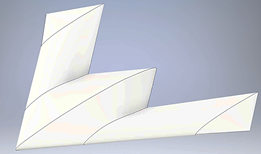
study numerically investigates the effect of leading-edge sweep angle on the aerodynamic performance of a generic Stability and Control Configuration (SACCON) unmanned combat aerial vehicle (UCAV). Three configurations with leading-edge sweep angles of 45°, 53°, and 60° were modelled and simulated using computational fluid dynamics (CFD) in ANSYS Fluent. A virtual wind-tunnel domain with a freestream velocity of 50 m/s was used, and the simulations were performed using the Spalart–Allmaras turbulence model at angles of attack of 5°, 10°, 15°, and 20°. The lift coefficient, drag coefficient, lift-to-drag ratio, and surface pressure distribution were evaluated for each configuration. The results show that the leading-edge sweep angle influences both lift and drag characteristics, particularly at higher angles of attack. The 53° reference configuration produced higher lift and drag at 20°, while the 45° configuration showed better lift-to-drag performance at higher angles of attack. The findings indicate that leading-edge sweep modification affects the aerodynamic efficiency of SACCON-type UCAV configurations and should be considered carefully in early-stage aerodynamic design.
References
Nickel, K., & Wohlfahrt, M. (1994). Tailless aircraft in theory and practice (E. Brown, Trans., 1st ed.). Butterworth-Heinemann; AIAA Education Series.
Wood, R. M., & Bauer, S. X. S. (2001). Flying wings/flying fuselages. In 39th AIAA Aerospace Sciences Meeting & Exhibit (AIAA Paper 2001-0311, pp. 1–26).
Liebeck, R. H. (2004). Design of the blended wing body subsonic transport. Journal of Aircraft, 41(1), 10–25.
Schuette, A., Hummel, D., & Hitzel, S. (2010). Numerical and experimental analyses of the vortical flow around the SACCON configuration. In 28th AIAA Applied Aerodynamics Conference (AIAA-2010-1400).
Luckring, J. M., et al. (2016). Objectives, approach, and scope for the AVT-183 diamond-wing investigations. Aerospace Science and Technology, 57, 2–17.
Hübner, A.-R. (2014). UCAV model design and static experimental investigations to estimate control device effectiveness and stability and control capabilities [Doctoral dissertation]. Core.ac.uk.
Loeser, T., Vicroy, D., & Schuette, A. (2010). SACCON static wind tunnel tests at DNW-NWB and 14 × 22 NASA LaRC. In 28th AIAA Applied Aerodynamics Conference (pp. 1–13).
Loeser, T., Vicroy, D., & Schuette, A. (2010). SACCON static wind tunnel tests at DNW-NWB and 14 × 22 NASA LaRC. In 28th AIAA Applied Aerodynamics Conference (p. 4393).
Schutte, A., Hummel, D., & Hitzel, S. M. (2010). Numerical and experimental analyses of the vortical flow around the SACCON configuration. In 28th AIAA Applied Aerodynamics Conference.
Cummings, R. M., & Schutte, A. (2012). Integrated computational/experimental approach to unmanned combat air vehicle stability and control estimation. Journal of Aircraft, 49(6).
Luckring, J. M., Boelens, O. J., Breitsamter, C., Hövelmann, A., Knoth, F., Malloy, D. J., & Deck, S. (2016). Objectives, approach, and scope for the AVT-183 diamond-wing investigations. Aerospace Science and Technology, 57, 2–17.
Gentry, G. L., Jr., Quinto, P. F., Gatlin, G. M., & Applin, Z. T. (1990). The Langley 14- by 22-foot subsonic tunnel: Description, flow characteristics, and guide for users. NASA. NASA NTRS
David, V. (2011). Development of a process and toolset to study UCAV flight mechanics using computational fluid dynamics (Chap. 4, pp. 50–51). University of Liverpool, United Kingdom.
Downloads
Published
Issue
Section
License
Copyright of articles that appear in Journal of Transpot System Engineering (JTSE) belongs exclusively to Penerbit Universiti Teknologi Malaysia (Penerbit UTM Press). This copyright covers the rights to reproduce the article, including reprints, electronic reproductions or any other reproductions of similar nature.
Disclaimer: The views and opinions expressed in the articles are those of the authors and do not necessarily reflect the official policy or position of the JTSE. Examples of analysis performed within are only examples and they should not be utilized in real-world. Assumptions made within the analysis are not reflective of the position of any JTSE entities.