SURFACE ROUGHNESS EFFECTS ON SLENDER BODY AERODYNAMICS: A REVIEW FOR SCALED ROCKET APPLICATIONS
DOI:
https://doi.org/10.11113/jtse.v13.263Keywords:
surface roughness, slender body aerodynamics, scaled rocket, boundary layer transition, drag prediction, equivalent sand-grain roughnessAbstract
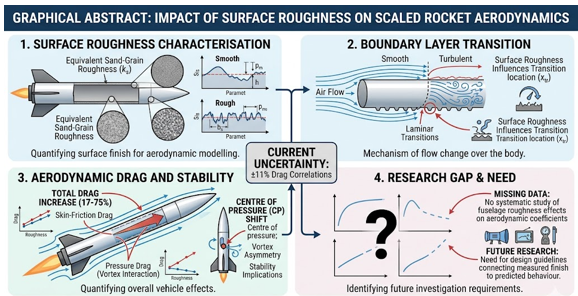
Surface roughness on rocket fuselage bodies has long been recognised as a factor in aerodynamic performance, yet how it specifically affects scaled rocket configurations is still not well understood. This paper reviews recent research on surface roughness effects in slender body aerodynamics, with a particular focus on scaled model rockets flying in the subsonic regime. The review covers four key areas: surface roughness characterisation and the equivalent sand-grain roughness; boundary layer transition mechanisms on cylindrical and slender bodies; quantitative drag and stability effects on complete vehicles; and how fuselage roughness influences centre of pressure and downstream flow behaviour. The findings show that roughness effects on slender bodies go well beyond skin-friction drag, modifying vortex asymmetry, control transition location, and alter the wake, all of which have stability implications. Current drag correlations carry ±11% uncertainty, and complete vehicle studies report drag increases of 17–75% for typical manufacturing roughness levels. Despite this body of work, a clear gap remains: no systematic study has isolated fuselage roughness effects on scaled rocket aerodynamic coefficients across a representative subsonic Mach and angle-of-attack envelope. This review lays the theoretical groundwork for such an investigation and highlights the need for design guidelines that connect measured surface finish to predicted aerodynamic behaviour in model rocketry.
References
Ahmed, M., Malik, Z., & Khan, S. (2020). Aerodynamic coefficients prediction for 122 mm rocket using CFD. Journal of Aerospace Engineering, 33(4), 1–12.
Berry, S. A., Horvath, T. J., & Kowalkowski, M. K. (2009). On the effects of surface roughness on boundary layer transition. NASA/TM-2009-215611.
Chen, X., Wang, Y., & Zhang, L. (2024). Review of flow control strategies for supersonic/hypersonic fluid dynamics. Aerospace Research Communications, 2024, 13149.
Chung, D., Hutchins, N., Schultz, M. P., & Flack, K. A. (2021). Predicting the drag of rough surfaces. Annual Review of Fluid Mechanics, 53, 439–471.
Di Renzo, M., & Pirozzoli, S. (2022). Direct numerical simulation of supersonic turbulent flows over rough surfaces. Journal of Fluid Mechanics, 942, A44.
Di Renzo, M., & Pirozzoli, S. (2025). Surface roughness effects on subsonic and supersonic turbulent boundary layers. Journal of Fluid Mechanics, 987, A12.
Ding, H., Wang, J., & Liu, P. (2015). Numerical investigation of surface roughness effects on circular cone-cylinder. International Journal of Aerospace Engineering, 2015, 285618907.
García-Gutiérrez, A., Crespo, J., & Navarro, R. (2022). Design and test of converging and de Laval nozzle using additive manufacturing. Frontiers in Aerospace Engineering, 2022, 951987.
Gramespacher, C., Brigham, J., & White, E. (2023). Boundary layer transition due to distributed roughness: Effect of roughness spacing. Journal of Fluid Mechanics, 960, A4.
Kumar, R., Singh, A., & Patel, M. (2025). Analysis of sand grain roughness effect on blunt reusable launch vehicle. Solar System Research, 59, 09574.
Lin, J. C., Howard, F. G., & Bushnell, D. M. (2016). Skin friction drag reduction on aircraft fuselage. AIAA Paper 2016-1267.
Peng, Y., Liu, X., & Wu, J. (2019). Experimental characterization of the supersonic transitional wake downstream of a single roughness element. Journal of Thermal Science, 28, 1198–1210.
Saha, S., Choi, H., & Kim, J. (2021). A review on turbulent flow over rough surfaces: Fundamentals and theories. Progress in Aerospace Sciences, 121, 100715.
Vermeersch, O., Charpin, F., & Deck, S. (2024). Surface roughness effects on transonic aircraft performance. Aerospace Science and Technology, 145, 106382.
Williams, O., Sahoo, D., & Smits, A. (2022). Characterizing streamwise development of surface roughness effects on a supersonic boundary layer. AIAA Journal, 60(6), 3570–3584.
Yadav, R., Gupta, S., & Sharma, P. (2022). Effect of surface roughness on aerodynamic performance of NACA 4412 airfoil. Materials Today: Proceedings, 56, 3007–3012.
Yang, H., Chen, S., & Li, F. (2024). Review on the research of high-speed boundary layer artificial transition. Proceedings of IUTAM Symposium on Transition, 2024.
Zhang, Y., Guo, X., & Wang, B. (2022). Influence of roughness on asymmetric flow field of slender body. International Journal of Aerospace Engineering, 2022, 6590152.
Zivojinovic, V., Pavlovic, M., & Stefanovic, Z. (2025). Aerodynamic modelling of rockets with RASAero II. Journal of Applied Computational Mathematics, 3(2), 8.
Downloads
Published
Issue
Section
License
Copyright of articles that appear in Journal of Transpot System Engineering (JTSE) belongs exclusively to Penerbit Universiti Teknologi Malaysia (Penerbit UTM Press). This copyright covers the rights to reproduce the article, including reprints, electronic reproductions or any other reproductions of similar nature.
Disclaimer: The views and opinions expressed in the articles are those of the authors and do not necessarily reflect the official policy or position of the JTSE. Examples of analysis performed within are only examples and they should not be utilized in real-world. Assumptions made within the analysis are not reflective of the position of any JTSE entities.